.svg)

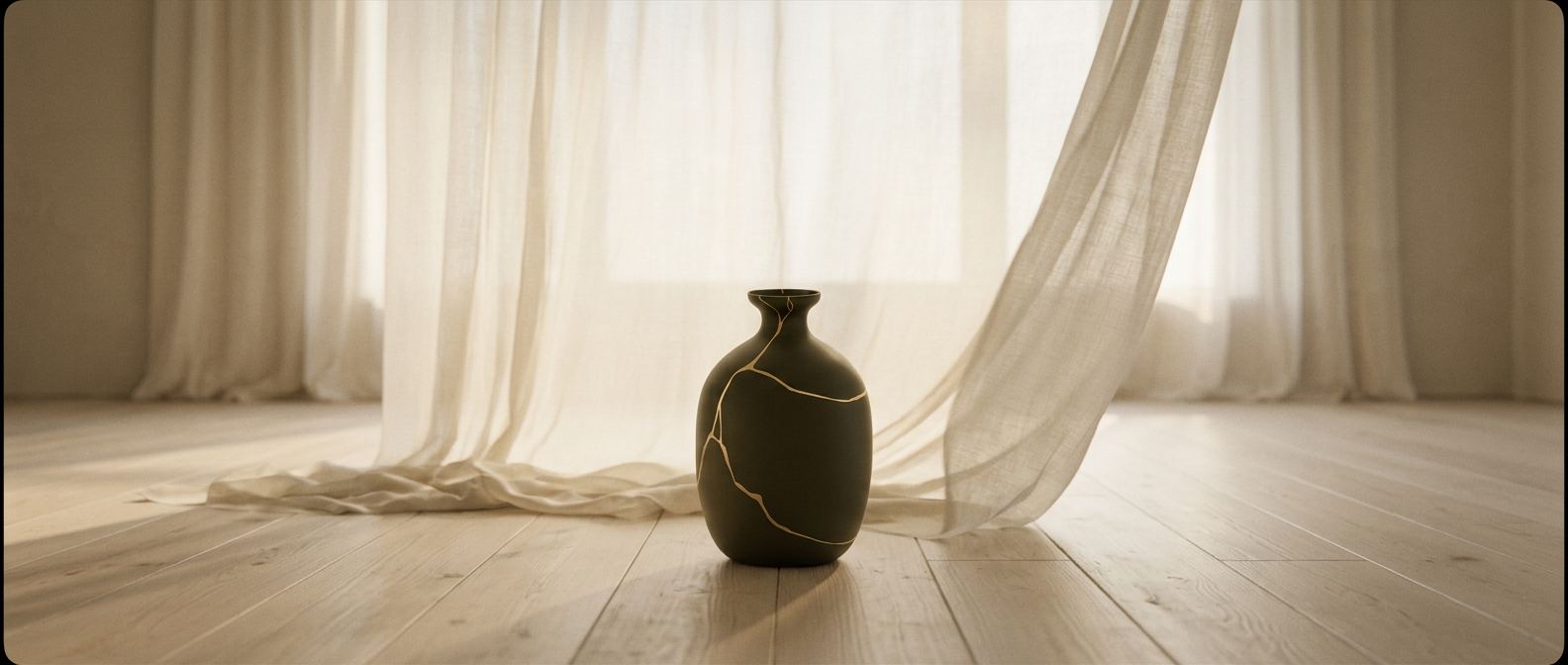
There's a bowl in Japan, four hundred years old, that's worth more today than the day it was made. Someone dropped it. It shattered. And instead of hiding the damage, they put it back together with gold.
That's kintsugi. It's also, as far as we can tell, a pretty accurate description of a human life.
What kintsugi actually means
The word says it plainly: kin (gold) and tsugi (joinery). Golden joinery, the Japanese art of repairing broken pottery so the thing that's broken becomes the most beautiful part of the piece.
It doesn't hide the break, or pretend the fall never happened. It traces the crack in gold, so you can't hold the bowl without holding its history.
The idea comes from wabi-sabi, a Japanese way of seeing that finds beauty in things that are worn, imperfect, and impermanent. A flawless object isn't the highest form of a thing. A thing that has lived is.
Yoga arrives at the same place from the other side. The Bhagavad Gita says happiness and hardship come and go like winter and summer, the work is learning to meet both without getting knocked over. Neither tradition promises you an unbroken lifel; but instead what you do with the pieces.
The part that stopped us
What's broken isn't lesser. It's more.
The cracks, the repairs, the history of a thing; that's exactly what gives it depth. To hide a scar is to be ashamed of the story. To fill it with gold is to honor it. We don't think that's a metaphor. We think it's a fairly literal description of what happens in life.
Why this belongs to yoga
“Yoga” comes from the Sanskrit yuj: to yoke, to unite, to join. Put that next to tsugi and something clicks: two traditions, born a continent apart, landed on almost the same word for the same act, making whole what came apart.
The classical teaching pictures the self wrapped in five layers, or koshas: body, breath, mind, awareness, and bliss. Not five broken pieces waiting for glue. Five coverings over a light that never actually went out, no matter what happened to you.
So one tradition says the gold goes into the crack. The other says the gold was under there the whole time. Both agree on the thing that matters: the fall doesn't make you any less.
What this means on the mat
We're not asking you to show up whole.
Most people who walk through our doors are carrying something: a grief, an injury, a hard year that took more than it gave. They say they're not flexible enough, not calm enough, not ready. You don't need to be whole to begin. More often than not, it's through the cracks that the strength shows.
So don't leave anything at the door. Bring it. There's a practical reason, too: the body is where the mind stores what it doesn't want to look at, and a long hold or a deep fold has a way of surfacing that. That's not the practice going wrong. That's the practice working.
Some days the honest practice is a strong, sweaty flow. Some days it's lying on the floor for an hour while everything softens and the mind finally goes quiet. Both count.
A sanctuary, not a fitness studio
Since we opened our first Las Vegas studio in early 2020, we've tried to build something other than a gym with a yoga room: a sanctuary, and a community of people helping each other become a little more whole.
Whatever you're carrying, there's a place on the floor for it. Come practice with us.
.svg)

